

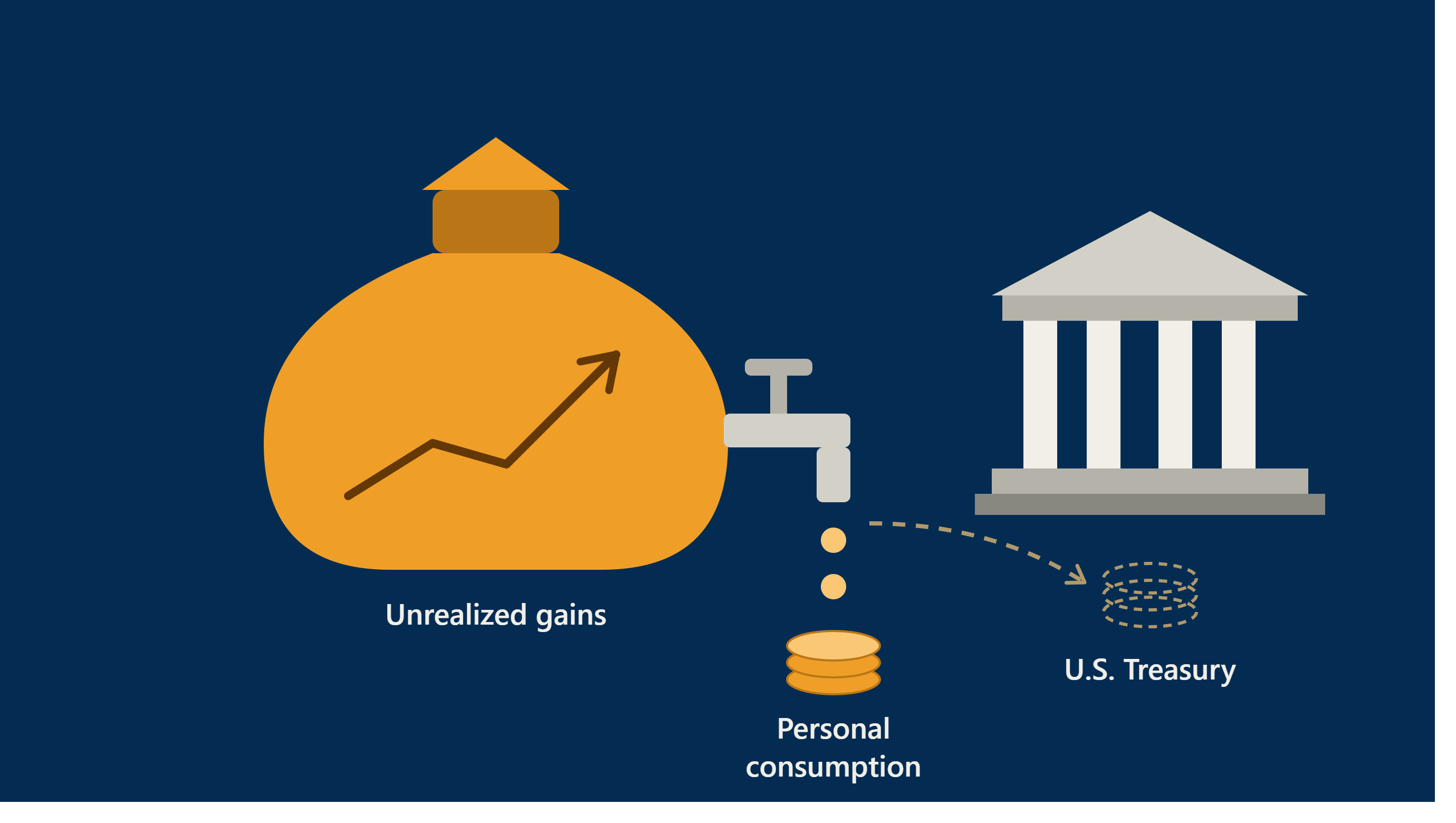
The top federal tax rate on long-term (i.e., held more than one year) capital gains is 23.8%, consisting of a 20% base rate plus the 3.8% Net Investment Income Tax. To be taxed, however, capital gains must be “realized,” which means the appreciated asset must be sold, exchanged, or disposed of in some other manner. The Internal Revenue Code imposes a statutory realization requirement, and many argue that the 16th Amendment authorizing a federal income tax imposes a constitutional realization requirement (although the Supreme Court has not ruled definitively). This means the federal tax system does not tax unrealized gains — i.e., mere appreciation in the value of an asset.1
People don’t like to pay taxes, of course. And some wealthy people really don’t like to sell their assets (e.g., part of their stock portfolio) and pay capital gains taxes when they want to spend money. That’s when sophisticated tax planning, like life, “finds a way.” And one particular strategy has gained a good deal of public attention recently as a way for the wealthiest Americans to unlock the value of their unrealized gains and spend it without paying taxes.
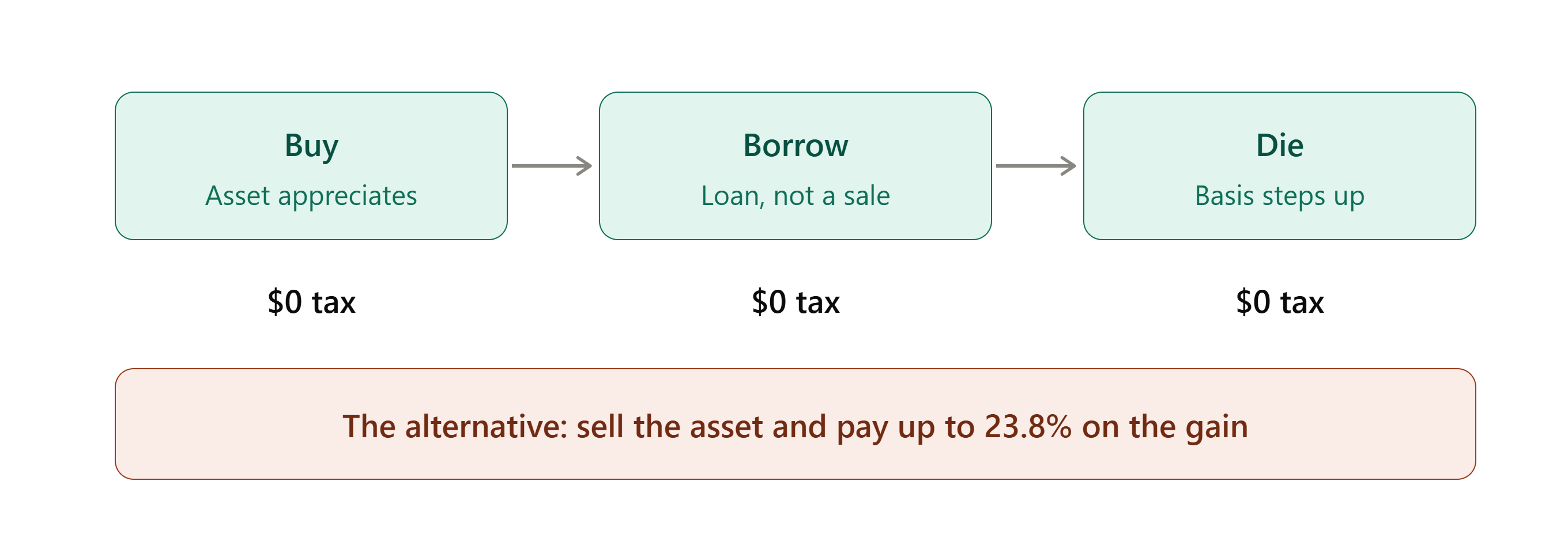
The strategy works like this: First, acquire an asset you expect to appreciate in value. Second, borrow against the asset once it does appreciate in value and use the proceeds for personal consumption. Third, die.
Wait, what?
Yes, die. When a taxpayer dies, the basis in that taxpayer’s appreciated assets is “stepped up” to fair market value, permanently wiping away any capital gains that accrued between the taxpayer’s acquisition of the asset and the taxpayer’s death. The heirs get a fresh start without having to worry about the appreciation that occurred before they received their inheritance. What tax folks call “step-up at death” is the critical piece of the “buy, borrow, die” tax strategy.
The strategy works best when the cost of borrowing (primarily interest payments) is less than the tax avoided and/or less than expected future appreciation of the asset. Upon death, the loan can be paid back out of the estate’s stepped-up assets, which previously may have been used as security for the loan. It’s what I call “monetization without realization.” The taxpayer is able to monetize gains without ever realizing gains, because realization is a taxable event.
What later came to be known as the “buy, borrow, die” strategy entered the public’s awareness because of one particular high-profile ultra-high-net-worth individual (“UHNWI”) who, many years ago, borrowed against shares in his own company to fund his personal lifestyle: Larry Ellison, co-founder of Oracle. To be honest, “found, borrow, die” is probably more precise, even if less alliterative, as the strategy is most valuable to founders and early-stage investors with little or no basis in stock that has appreciated dramatically.
But what matters substantively is whether the proceeds are for the purpose of consuming with tax-free income. Borrowing to finance business expansion, margin trading, and the like is fine. Pledging appreciated assets to obtain financing for business and investment activities is standard practice, not tax avoidance. For example, Mr. Ellison pledged another 6% of his Oracle shares in fiscal year 2025, but to the extent those proceeds served as part of the Paramount Global acquisition, they aren’t an instance of monetization without realization. To the extent those proceeds are used to buy a new yacht, they are.
More generally, borrowing against the same asset you are buying doesn’t strike me as the kind of tax avoidance we are talking about here. Whether it’s a home mortgage, margin trading, or a leveraged buyout of a company,2 people can debate whether the tax treatment of debt-financed investment is too generous, but that’s just not the same as borrowing to consume and avoid capital gains taxes.
Recent Research on Borrowing by UHNWIs
A new research paper from Edward Fox (Michigan Law) and Zachary Liscow (Yale Law) attempts to measure the prevalence of the “buy, borrow, die” strategy among the rich. They look separately at the top 1% and the top 0.1%, using 2022 data that puts the net worth thresholds of those two groups at $14 million and up and $62 million and up, respectively. Their research provides some interesting evidence about what is going on amongst the wealthiest American households. First, about 60% of the total economic income of the top 1% is already captured by the tax system, while 40% is attributable to unrealized gains. For the top 0.1%, this split shifts closer to 50-50.
After doing a bunch of calculations, they conclude that “‘buy, borrow, die’ is not a primary tax avoidance strategy of the very rich.” And while Fox and Liscow added some important nuances to this sweeping conclusion in subsequent pieces, some have latched onto this statement to insist that, to paraphrase Obi-Wan Kenobi, “This isn’t the tax avoidance you’re looking for.” The Washington Post editorial board, for instance, pounced to declare that the “buy, borrow, die” strategy is a “myth.”
I find this conclusion odd for a couple of reasons.
First, Fox and Liscow exclude the Forbes 400, i.e., the 400 wealthiest individuals in the country, from the borrowing data. (This is due to data limitations, not to the authors’ choice.) That means the three individuals they themselves cite as examples of “executive at public companies borrowing large sums against their stock” — Ellison, Musk, and Carl Icahn — are not even included in their borrowing totals. Neither are the other 397 wealthiest individuals. The cut-off for making the Forbes 400 in 2026 is $4.4 billion, 70 times the Fox and Liscow cut-off for making the top 0.1% and 300 times the cut-off for the top 1%. In other words, there is real money here.
So, it seems like Fox and Liscow left some words off of their conclusion above. At a minimum, I’d edit it to read, “‘buy, borrow, die’ is not a primary tax avoidance strategy of the very rich, if we ignore the 400 richest taxpayers who are most likely to use it.”
That said, Fox and Liscow base their conclusion on a measurement that wouldn’t change much if the Forbes 400 were included: borrowing as a percentage of unrealized gains.3 Looking at the top 1% excluding the Forbes 400, they estimate $1 trillion in borrowing against about $23 trillion in unrealized gains, or borrowing of “only” 4.4% of unrealized gains. They impute unrealized gains of $2.24 trillion for the Forbes 400, and in a separate 2024 paper, they estimate borrowing by the Forbes 400 at $100 billion. This gives a ratio of borrowing to unrealized gains of 4.5% — nearly identical to the rest of the top 1%.
And this is my second, and probably more important, beef with their conclusion: it’s based on a percentage. Yes, I agree that borrowing as a percentage of unrealized gains is very small. In fact, I think this finding makes a very important contribution to tax policy debates. Advocates of broad-based taxes on unrealized gains (e.g., annual mark-to-market taxation) and wealth have used “buy, borrow, die” as a poster child of why we need these taxes. Fox and Liscow, however, show that borrowing to avoid tax is a tiny fraction of what would be hit by these tax proposals. Subjecting $1,000 of capital to an economically destructive tax just to capture a single-digit percentage of that $1,000 is bad tax policy. Much better to target the small percentage with a loophole closer than to impose a broad-based tax on the entire $1,000.
Where I disagree is that “percentage” should be the basis for determining whether “buy, borrow, die” is a major tax avoidance strategy. The problem is that a percentage is really a ratio, and a ratio consists of two numbers: a numerator and a denominator. I can make a percentage look really, really small by making the denominator really, really big.
And in this case, the denominator is in the tens of trillions of dollars. That borrowing is only 4.4% of unrealized gains for the top 1% doesn’t mean that borrowing is small. It means that unrealized gains are enormous (and growing every year). What matters most for assessing whether “buy, borrow, die” is a major tax avoidance strategy isn’t whether it’s a small or large percentage of economic income or unrealized gains; it’s how much revenue is being denied to the federal treasury as a result of the strategy’s use — measured in dollars, not percentages. (To be fair, Fox and Liscow seem to acknowledge as much in a subsequent Tax Policy Center blog post where they clarify, “Buy-borrow-die is a real loophole, and in absolute terms the rich borrow a lot.”)
Securities-Based Borrowing by Wealth Group
Sources: Survey of Consumer Finances, Fox & Liscow (2025), Fox & Liscow (2024)
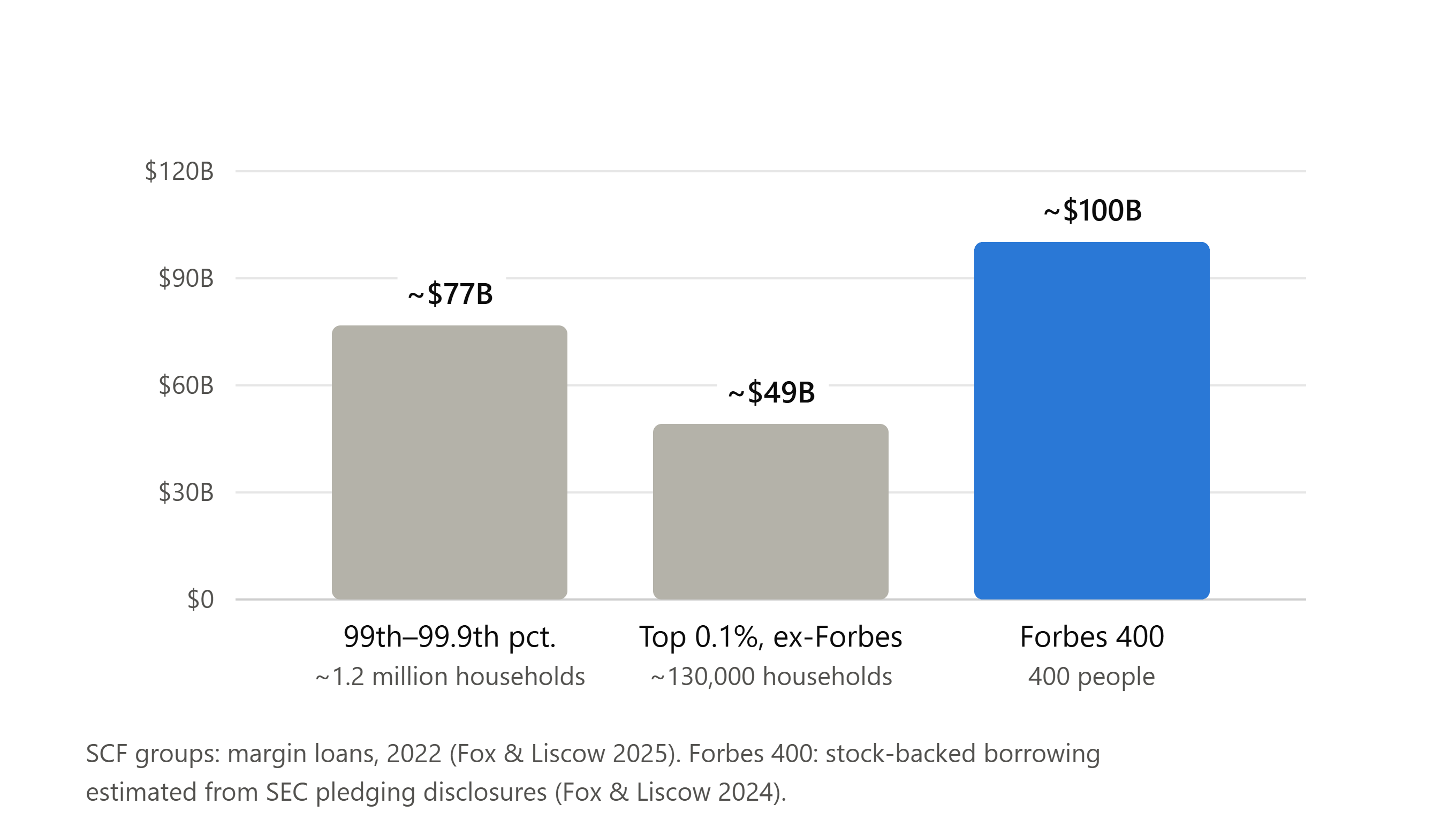
If we look at only a subset of borrowing — borrowing by households against publicly traded stock (which Fox and Liscow believe better captures borrowing to finance consumption) — we see both that the raw dollars are significant and that leaving out the Forbes 400 leaves a huge hole in the analysis.
As we can see, stock-based borrowing by households in the Forbes 400 is more than double that by the rest of the top 0.1%. It’s also more than the stock-based borrowing of the 1.2 million households who make up the rest of the top 1%. At an estimated $100 billion in 2024, that’s a lot of potential “monetization without realization.” Caveat, though: this figure doesn’t exclude practices such as household-level margin trading, so it might overstate the amount being borrowed for consumption purposes. Unfortunately, I haven’t been able to find data that slices securities-backed borrowing that thinly.
(Another minor caveat: The Forbes 400 figure is a Fox and Liscow 2024 estimate, whereas the other figures come from Fox’s and Liscow’s analysis of the 2022 Survey of Consumer Finances.)
Proposals to Address the Lost Revenue
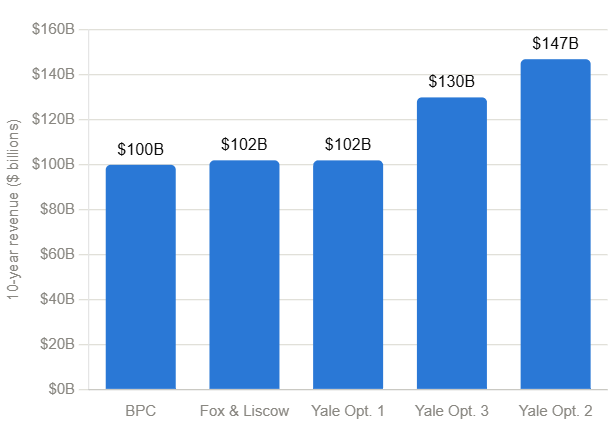
So, how much revenue is the treasury losing due to the “buy, borrow, die” strategy, and what can policymakers do about it? Various commentators have offered up ideas, and although they are very different, they all share a common thread: collecting at least some of the tax revenue that should have been collected had taxpayers sold assets for cash and paid tax on the capital gain. I’m not endorsing any specific proposal at the moment, but I do think they are all worthy of discussion. In fact, they all raise a similar amount of revenue, making it easier to evaluate them against each other based on the policy merits.
Five Proposals to Close the “Buy, Borrow, Die” Loophole
Sources: Bipartisan Policy Center, Fox & Liscow, The Budget Lab at Yale.
Interestingly, given the “nothing to see here” tone of their paper, in a separate piece Fox and Liscow propose to close the loophole and estimate that their proposal would raise $102 billion over ten years. Their proposal would trigger a deemed sale (i.e., realization) when taxpayers pledge assets to borrow, using a first-in, first-out (FIFO) rule to determine which assets are “sold,” resulting in taxable capital gain. They would phase in the tax for taxpayers with net worth from $100 million to $200 million, and provide an annual exemption of $200,000 in borrowing plus a lifetime exemption of $1 million on top of that. They limit their proposal to “major assets,” a definition which excludes assets like homes and art.
Their revenue estimate is probably too high, for various reasons I won’t get into here. But at a minimum, their proposal raises several tens of billions of dollars over a decade. Distributionally, they estimate that half of the revenue comes from billionaires, with 90% of that coming from the Forbes 400. That 45% of their revenue comes from the Forbes 400 reinforces how awkward their other paper’s conclusion is that the tax avoidance strategy isn’t prevalent while excluding the Forbes 400 from their analysis.
Another option, developed last year by the Bipartisan Policy Center and scored by the Tax Foundation, would impose a one-time 8% excise tax on funds withdrawn from securities-backed lines of credit (SBLOCs) and would raise $100 billion over ten years. The Budget Lab at Yale, meanwhile, has offered three different options for reducing the strategy’s tax advantage. Those options raised between $102 billion and $147 billion over a decade. I won’t go into detail on each of them here, but they all work differently than the BPC option and they all apply to a broader universe of assets than just securities.
For now, I’m flagging these five proposals mostly because, despite being very different in design, they all raise a similar amount of revenue. Despite Fox and Liscow’s conclusion that “buy, borrow, die” isn’t a primary tax avoidance strategy, my view is that losing $100 billion over ten years (give or take a few tens of billions in either direction) from UHNWI capital gains tax avoidance is meaningful enough to consider addressing through legislation.
Liscow’s Alternative Tax Increases
That’s especially true given some of the alternative revenue raisers they suggest. In a recent New York Times op-ed, Liscow supplements his “not a primary tax avoidance strategy” conclusion with an alternative tax-increase proposal: raising federal income tax rates. Liscow argues that it would be better to “[r]estore the top marginal ordinary income tax rate to its pre-2017 level of 39.6 percent.” He then goes on to endorse “raising the corporate tax rate from 21 percent toward the 35 percent it had been set at historically.”
Today’s top federal marginal tax rate amounts to 40.8% — the top 37% bracket plus the 3.8% Medicare payroll tax (on labor income) or the 3.8% Net Investment Income Tax (on passive income). Based on recent research from economists at the Joint Committee on Taxation, this might already be the revenue-maximizing rate, meaning raising it higher damages the economy without raising more revenue. Add to that state income taxes and in some states, the top marginal tax rate on income is well over 50%.
The corporate rate? How quickly we forget that at 35% — nearly 40% including the average state corporate tax rate — before 2018 we had the highest corporate rate in the developed world. And the consequences of that were waves of American companies reincorporating as foreign companies to escape the U.S. tax net and high levels of U.S. profit-shifting to tax havens. Tax strategies called “corporate inversion” and “double Irish” had become household terms as American companies fled the country in droves. When was the last time you heard those terms used in a current context? Probably 2017, when Congress cut the corporate rate to 21%. And Liscow wants to return to that?
No, thank you.
To his credit, Liscow rejects annual taxes on wealth and unrealized gains. But rather than raise roughly $100 billion by ensuring UHNWIs engaging in tax avoidance pay more than 0% when they monetize capital gains for personal consumption, he’d rather make salaried professionals, owners of family businesses, and American corporations competing globally pay 40% or more. Raising taxes on productive taxpayers already paying the highest tax rates so that some can play games to avoid paying the 23.8% capital gains tax rate strikes me as a case of misplaced priorities.
“Borrow” vs. “Die”
All that said, the proposals above attempt to end the strategy by kicking out the second of the stool’s three legs: the ability to use non-taxable borrowing to avoid taxable selling. That is, admittedly, a bit of a band-aid solution because the real driver of this and much other tax avoidance by UHNWIs comes from abuse of the third leg: full step-up in basis at death, or the “die” leg. Fox and Liscow make this argument themselves in their TPC blog post. Kicking out this leg by, say, treating transfers of assets to heirs at death as a realization event in the same manner as a sale or other disposition would probably do much to end this particular type of tax avoidance, as well as many others. But this is a much bigger change with significant unrelated and unintended economic consequences, especially in the context of retaining an estate tax (which already taxes much of the same base as taxing capital gains at death would).
Treating transfers at death the same as a sale would address a substantial number of tax administration problems and economic distortions. Currently, the incentive to hold appreciated assets until death creates a “lock-in” effect whereby taxpayers sit on capital that should be redeployed to other, more productive investments. Investment decisions are made to minimize taxes rather than to maximize pre-tax profits, to the detriment of the economy. On the other hand, triggering a taxable event at death with respect to appreciated but illiquid assets creates its own set of problems and inequities, as we know from our experience with the estate tax.
Because of this new set of problems, repealing step-up at death is probably not the way to deal with the narrow task of eliminating the “buy, borrow, die” loophole. The current step-up rule should only be reconsidered in the broader context of how to tax bequests and inheritances, including what to do with that complete mess of a tax regime called the estate tax.
There are a handful of exceptions, where narrowly targeted tax rules do tax unrealized income in specific situations where big loopholes would otherwise exist.
For example, Elon Musk’s acquisition of Twitter. Interestingly, Musk originally planned to borrow against his own Tesla shares to finance the acquisition, but ultimately it was structured more like a traditional buyout where the debt was secured by the target company’s assets.
They also use borrowing as a percentage of total economic income, which is an even smaller ratio.