


Is the fact that this family pays tax once not twice on their business income a “tax loophole”? (Image is AI-generated.)
Back in 2013, brothers Tom and Jeff Bloom won the Farm Equipment Dealership of the Year Award. Their farm equipment dealership, Lake County International, which they took over from their father after his unexpected death, had just one location in South Dakota with 22 employees, and just over $25 million in revenue.
Just over $25 million in revenue.
Why do I repeat myself? Well, that’s the line some advocates of higher taxes on businesses have drawn to declare a business so big that allowing it to continue to be treated as a pass-through entity (such as an S corporation or partnership) is a tax loophole that must be closed. Our friends at the NYU Tax Law Center (TLC), for example, publishing through the Hamilton Project at the Brookings Institution, have proposed to force all pass-through entities with over $25 million in gross receipts — such as the Bloom family’s single dealership in South Dakota — to convert to C corporations and be subject to double taxation.
They estimate this would force 83,000 businesses — roughly two-thirds of which are S corporations and one-third of which are partnerships — to restructure themselves into C corporations, pay the corporate income tax, and then pay individual-level taxes on dividends and capital gains. They propose this major disruption to tens of thousands of family businesses for the purpose of raising… $140 billion over ten years. By comparison, CBO has estimated that simply raising the corporate tax rate by one percentage point, from 21% to 22%, would raise $136 billion.1
So, who exactly are these “large, complex, and corporate-like” businesses that the experts want to double tax? Here are some examples of family businesses where the average business in that industry exceeds the $25 million threshold:

Sources: National Automobile Dealers Association (2025), National Beer Wholesalers Association (2019), National Grocers Association (2025), National Association of Convenience Stores (2026); author’s calculations.
The average car dealership, the average beer distributor, two of the average local grocery stores under common ownership, and five average-sized gas stations with convenience stores under common ownership would qualify as “large, complex, and corporate-like” businesses that the TLC proposal would force to convert to C corporations.
Multiplying the Tax Base Isn’t Broadening the Tax Base
As readers of my newsletter know, I’m all for broadening the tax base when tax provisions distort the free market, pick winners and losers, add complexity, and represent hidden government spending in the tax code. But imposing two layers of tax on income that already bears one layer isn’t base broadening. It’s base multiplying. One can raise a lot of revenue by taxing the same income again and again, but that doesn’t make it sound tax policy.
Some progressives, however, have manufactured a narrative inside their echo chamber to the effect that double taxation of business income is the “right” or “neutral” answer, and therefore taxing business income once and only once is somehow erosion of the tax base, tax avoidance, and a loophole that must be shut down.
Excuse me?
It has always been a principle of good tax policy that taxing income once is sound, and that both double taxation and non-taxation of income are distortive. People will argue until the End Times whether tax rates should be higher or lower, but the principle that those rates should be applied to an item of income once and only once remains. Rather than seeking to double tax family businesses, we should be pursuing corporate integration, so that corporate profits are taxed exactly once — neither zero times nor twice — either at the entity level or at the shareholder level. Rather than taxing pass-through businesses as corporations, we should be taxing corporations more like pass-throughs.2
That said, publicly traded C corporations have already achieved a substantial degree of corporate integration. A 2024 research paper by Steve Rosenthal and Livia Mucciolo of the Tax Policy Center estimated that 72% of publicly traded stock was owned outside of taxable accounts, mostly by foreign investors, tax-preferred retirement accounts, pension funds, and non-profit entities such as university endowments. Much of this results from tax-indifferent investors owning index funds that include shares of public companies.
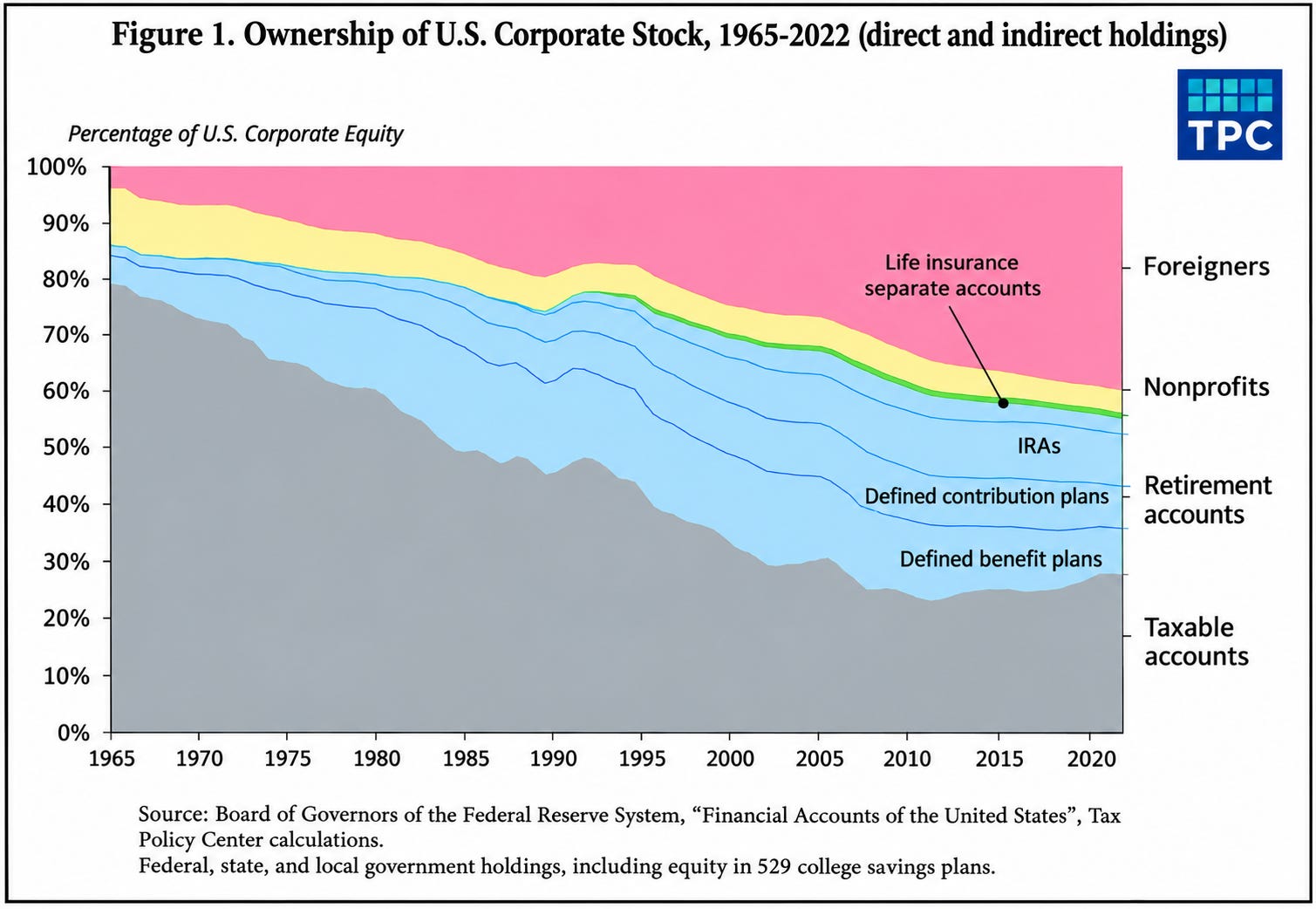
Source: Graphic reproduced from Steven M. Rosenthal and Livia Mucciolo, “Who’s Left to Tax? Grappling With a Dwindling Shareholder Tax Base,” Tax Notes Federal, April 1, 2024.
Privately-owned businesses, however, usually cannot avail themselves of this kind of relief from double taxation. They often are owned by fully taxable U.S. individuals, who must pay a second layer of tax. A family-owned S corporation may not have institutional or foreign investors, and cannot be included in index funds. Thus, for these businesses, requiring conversion to C corporation status does not put them on a level playing field with publicly traded companies; it puts them at a tax disadvantage to them.
Even University of Michigan professor Reuven Avi-Yonah, known as a left-leaning tax academic who often supports higher taxes, found himself perplexed by the TLC proposal:
Given the corporate tax’s complexity and the transaction costs it imposes both taxpayers and the IRS, it should be eliminated unless a better justification exists than voters’ misperception of who ultimately bears the corporate tax burden. Most of the traditional arguments for maintaining the tax are unconvincing, as is the Tax Law Center’s proposal to expand it beyond what is strictly necessary.
Avi-Yonah points out that the TLC proposal would cause a large law firm to be taxed at a 21% rate instead of the partners paying a 37% rate, and concludes, “Nothing in the Tax Law Center proposal justifies such a bizarre outcome.”
Which brings us to the next problem: “pass-through businesses” are not all alike.
There Isn’t One Business Entity Called “PartnershipandScorporation”
While two-thirds of the businesses affected by the proposal are S corporations, most of the TLC’s justifications for this move relate to the unique tax administration challenges presented by complex, multi-tiered partnerships. The report discusses features unique to partnership taxation such as special allocations, multi-tiered entity structures, circular ownership, and audit challenges. It does try to identify one type of “tax avoidance” by S corporations when it claims that “S corporation owners exploit a well-known loophole to avoid both the net investment income tax (NIIT) and employment taxes.” I debunked the myth, however, that not applying the NIIT to the active business income of S corporations is some sort of a loophole in a Tax Notes commentary I published in July, so I won’t repeat myself here.
Bottom line: While the authors of the TLC proposal dedicate one sentence to the (already debunked) tax avoidance of S corporations, they dedicate several pages to partnerships.
The authors repeatedly adopt a strategy of blurring lines that shouldn’t be blurred for the purpose of promoting a one-size-fits-all tax increase. First, they refer to “large and complex” businesses, but “large” and “complex” are not synonyms. In fact, by law, S corporations are simple regardless of size. They may only have individuals as owners,3 and those individuals are fully taxable on their S corporation profits either because they are U.S. persons or they are foreign persons who own their S corporation shares indirectly through a special kind of taxable U.S. trust. S corporations are limited to 100 shareholders. They may only issue one class of stock — none of the special allocations that can make partnerships so complex — and tax attributes, including income, are allocated on a pro rata basis.
Put simply, there is no such thing as a “complex” S corporation. And yet, the authors sweep them into their “large and complex” framing through another merger of non-similar concepts. Rather than treat partnerships and S corporations separately, they simply refer to “pass-through entities” as if they all work the same. It’s really quite a sleight of hand: cite the complexity of large, multi-tiered partnerships as a reason to double-tax simple, single-tiered S corporations. Because, you know, they’re all “pass-throughs.”
But that reasoning is like saying that because big Silicon Valley venture capital funds are complex and opaque — and therefore vehicles for tax avoidance — we should raise taxes on… car dealerships. In fact, that’s not “like” what they are saying. That is what they are saying.
Earlier this month, Rogé Karma of The Atlantic published a piece parroting many of the same arguments about complex, multi-tiered partnerships put forward by the TLC, and then used the same sleight-of-hand to argue these concerns justify going after “pass-throughs” more generally.
Karma relies heavily on one particular academic study to support his case that pass-throughs are undertaxed, with an effective rate of 19%. But the authors of that 2016 study estimated the effective rate on S corporations to be 25% and on partnerships to be 16%. In fact, S corporations and partnerships are very different kinds of business entities, with one result being that they pay very different effective tax rates. Lumping them together makes little sense. But Karma, the TLC staff, and other progressive tax policy commentators prefer to do just that and then propose remedial tax increases that would apply to both.
So why do partnerships enjoy such a low effective rate? The authors of the 2016 study on which Karma relies identify the preferential rate on capital gains and dividends as the #1 reason. In other words, partnerships are used as investment funds (duh!), where investors who would pay the preferential rate if they invested on their own pool their resources and invest together at… the same preferential rate. The cause of a low tax rate isn’t the choice to use the partnership form; it’s the capital gains rate, which applies whether you invest through a partnership or on your own.
The #2 reason they identify is that tax-exempt persons invest in the United States through partnerships. As with shareholders in C corporations, tax-exempt investors include institutions like pension funds, university endowments, and certain foreign investors like sovereign wealth funds. So, like with the first reason, this isn’t about partnerships. This is about the tax rules that apply to pensions, universities, and foreign investors. On those first two, Congress explicitly provided tax preferences for retirement security and for charitable organizations dedicated to education for policy reasons that have nothing to do with partnership structures. The taxation of foreign investors in the United States is more complicated, but mostly has to do with long-standing international tax principles granting the jurisdiction of the investor’s residence the primary right to tax the investment gains, rather than the jurisdiction that is the source of the income.
As an aside, large partnerships tend to be dominated by investment funds (e.g., hedge funds, private equity, real estate, venture capital), accounting for more than half of total partnership assets and income. They act as entities that allow investors to pool resources without adding another layer of tax. Why an investor should be taxed once if investing on his or her own, but double taxed if pooling resources with other investors, I cannot fathom. S corporations, on the other hand, tend to be what people think of as traditional operating businesses: manufacturers, construction firms, wholesalers, and retailers comprising the lion’s share. And they play by rules that prevent them from being “complex.”
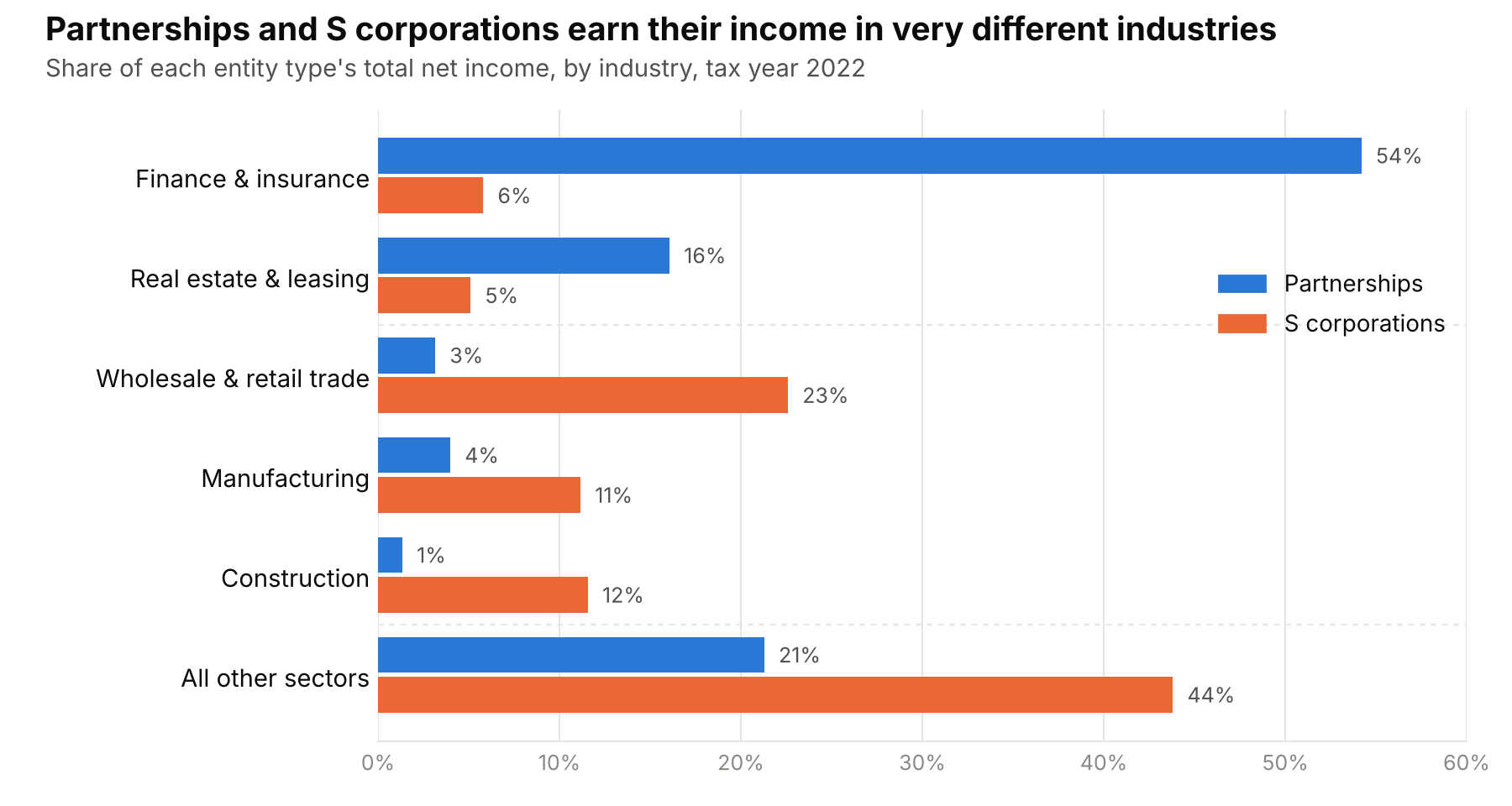
Source: IRS Statistics of Income, Partnership Returns Table 10 (TY 2022) and Corporation Complete Report Table 7, Form 1120-S (TY 2022).
This does not mean complex partnerships aren’t vulnerable to tax avoidance; they are. Nor does it mean that Congress, Treasury, and the IRS shouldn’t continue searching for ways (including increased use of AI) to increase tax compliance by complex partnerships; they should. My point is that the headline “Pass-Throughs Aren’t Taxed Enough Compared to C Corporations” looks very different when you dive into what’s really going on.
$140 Billion on a False Premise
Circling back to the TLC proposal, the problem isn’t that $25 million is too low. The problem is that using a gross receipts limit — or any kind of size-based standard — to draw a line between pass-through businesses and C corporations is based on a false premise. Raising the threshold to $100 million or $1 billion wouldn’t fix the proposal, because size isn’t what matters. Ownership structure, such as the differences between a closely-held business and a publicly traded business, matters far more in distinguishing businesses than whether sales fall above or below some arbitrary line.
As Avi-Yonah explains:
The parity issue is problematic, because it’s unclear why a partnership or S corporation with over $25 million in gross income is more like a C corporation than a smaller partnership or S corporation. The current dividing line is that almost all publicly traded entities are taxed as C corporations. That makes sense because in most cases, it is impossible to attribute their income to ever-changing shareholders.
It’s the corporate income tax that is the deviation from the ideal of taxing owners directly on business profits. We have it because of the practical difficulties of taxing shareholders in public companies who literally might only own shares for nanoseconds (think high frequency trading). This challenge doesn’t generally exist with closely-held businesses and funds. And to the extent policymakers want more parity in how different businesses are taxed, they should focus on corporate integration rather than expanding double taxation.
I’m not advocating for raising the corporate tax rate, but I offer this comparison to illustrate the huge gulf in tax complexity and economic disruption between two proposals that raise the same amount of revenue.
There are practical limitations to simply applying the partnership or S corporation tax rules to C corporations, and in future editions of this newsletter I hope to explore specific methods of moving towards corporation integration.
I’m ignoring the special case of “S-ESOPs” — S corporations with Employee Stock Ownership Plans. Shares owned by the ESOP receive tax deferral, meaning neither the entity nor the shareholder are taxed currently on the business income. That indeed can lead to non-taxation, but Congress intended that result to encourage employee ownership and so it’s not a true loophole. Whether Congress made the right policy decision is outside the scope of today’s discussion.